 By
By Two formats. Same compound. Very different consumption experiences.
7-OH edibles and 7-OH tablets are the two most popular formats on the market. Both deliver pre-measured doses. Both are easy for newcomers to use. But they differ in onset speed, taste, portability, and overall experience.
This guide breaks down 7-OH edibles vs traditional tablets across the eight things that actually matter when you’re picking a format.
The Quick Verdict
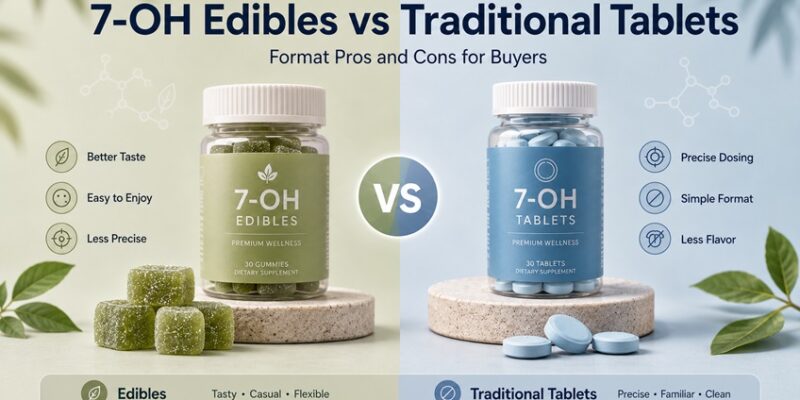
Edibles are slower, sweeter, and more enjoyable to consume. Tablets are faster, more discreet, and easier to dose precisely. Edibles fit casual use; tablets fit consistent routines.
Now the full comparison.
What Counts as a 7-OH Edible?
In the 7-OH product world, “edibles” is a broad category that includes:
- Gummies (the most common edible format)
- Chewables and soft chews
- Chocolates (less common but available)
- Mints and lozenges
- Hard candies
What makes them edibles: they’re food-like products designed to be chewed or eaten, with 7-OH infused into the formulation.
What Counts as a 7-OH Tablet?
A 7-OH tablet is a compressed pill containing a precise amount of 7-hydroxymitragynine, with pharmaceutical-grade binders that hold the tablet together.
Tablets are:
- Solid and uniform in shape
- Precisely dosed
- Designed to be swallowed with water (or in some cases, dissolved sublingually)
- Not flavored or sweetened (or only minimally)
You can browse 7-OH tablets at 7OH.com to see how the format is presented across multiple potency tiers.
Side-by-Side Comparison Table
| Feature | 7-OH Edibles | 7-OH Tablets |
|---|---|---|
| Format | Chewable, food-like | Compressed pill |
| Taste | Sweet, flavored | Bitter, minimal flavor |
| Onset speed | Slower (30 to 60 min) | Standard oral speed (20 to 45 min) |
| Dosing precision | Pre-measured per piece | Pre-measured per tablet |
| Portability | Moderate | Excellent |
| Discretion | Low (looks like candy) | High (looks like a vitamin) |
| Travel friendliness | Good | Excellent |
| Calories per serving | 5 to 30+ calories | Minimal |
| Sugar content | Yes (most edibles) | None |
| Best for | Casual, flavor-focused use | Daily, routine use |
Round 1: Taste
Edibles win, easily.
7-OH has a notoriously bitter, earthy flavor when consumed raw. Edibles are formulated specifically to mask or balance that bitterness with sweet, fruity, or chocolate flavors.
A 7-OH gummy can taste like candy. A 7-OH tablet, even if you crush it accidentally, tastes terrible.
For people who care about the experience of consumption, edibles are dramatically more pleasant.
Verdict: Edibles, no contest.
Round 2: Discretion
Tablets win.
A tablet looks like any vitamin or supplement. You can take one in public, at work, or in front of family and no one will think twice.
Edibles, especially gummies, look like candy. They might be eye-catching, prompt questions (“ooh, what flavor is that?”), and feel less private to consume.
Verdict: Tablets, by a clear margin.
Round 3: Onset Speed
Tablets edge ahead.
Both formats go through digestion, but tablets typically dissolve and absorb slightly faster than edibles. Edibles have to be chewed and broken down by saliva, then digested through the same pathway.
The difference is small (often just 10 to 20 minutes), but for users who want predictable timing, tablets are slightly more reliable.
Verdict: Tablets, by a small margin.
Round 4: Dosing Precision
Tied.
Both formats are pre-measured by the manufacturer. Both deliver consistent milligram amounts per piece. Neither requires a scale.
The difference: tablets often come in finer milligram increments (5mg, 10mg, 15mg, etc.), while edibles tend to be available in larger increments (10mg, 25mg, 50mg per gummy).
If you want fine dose control, tablets win. If you’re happy with standard increments, both are equivalent.
Verdict: Tied for full doses, slight edge to tablets for fine increments.
Round 5: Portability
Tablets win.
Tablets are small, hard, and don’t melt. A bottle of 30 tablets fits in a pocket or small bag with no concerns.
Edibles, especially gummies, are sensitive to heat. Leave them in a hot car and they’ll melt or stick together. Even in good conditions, jars of gummies take up more space than tablet bottles.
Verdict: Tablets, especially in warm climates or summer months.
Round 6: Calorie and Sugar Content
Tablets win.
A typical 7-OH gummy contains 5 to 30 calories of sugar and gelatin. If you’re eating multiple gummies per day, that adds up to noticeable extra sugar in your diet.
Tablets contain no meaningful calories or sugar. They’re formulated with inert binders and the active ingredient.
For diet-conscious buyers, tablets are the cleaner choice.
Verdict: Tablets.
Round 7: Storage and Shelf Life
Tablets win.
Both formats have manufacturer-stated shelf lives of 12 to 24 months when sealed. But:
- Edibles are sensitive to heat, moisture, and time. Gummies dry out, chocolates can develop fat bloom, and overall texture degrades.
- Tablets are more resilient. As long as moisture is kept out (desiccant packs help), tablets maintain their integrity well.
For long-term storage, tablets hold up better.
Verdict: Tablets.
Round 8: Cost Per Milligram
Roughly tied, with slight edge to tablets at higher doses.
Edibles tend to cost slightly more per milligram than tablets, partly because of the additional ingredients (flavorings, sweeteners, gelatin) and the more complex manufacturing process.
The difference is small at low doses and grows at higher doses, where tablets in the 50mg+ range often deliver the most cost-effective per-mg pricing.
Verdict: Slight edge to tablets, especially for high-dose buyers.
Final Scorecard
| Round | Winner |
|---|---|
| Taste | Edibles |
| Discretion | Tablets |
| Onset speed | Tablets |
| Dosing precision | Tablets (slight edge for fine doses) |
| Portability | Tablets |
| Calorie content | Tablets |
| Storage and shelf life | Tablets |
| Cost per milligram | Tablets (slight edge) |
Final score: Tablets 7, Edibles 1.
Tablets win on most practical metrics. Edibles win only on taste, but that single category matters more to some buyers than all the others combined.
If consumption experience matters to you, choose edibles. If practicality matters more, choose tablets. You can explore both formats at 7OH.com to see what’s available.
Who Should Buy 7-OH Edibles?
Edibles are the better fit if you:
- Hate the taste of bitter compounds
- Use 7-OH casually or recreationally
- Are at home most of the time you use it
- Don’t worry about sugar or calorie content
- Like a candy-style consumption experience
- Don’t mind a slower onset
- Have proper at-home storage (cool, sealed)
Who Should Buy 7-OH Tablets?
Tablets are the better fit if you:
- Want maximum portability and discretion
- Use 7-OH consistently as part of a daily routine
- Need fine-grained dose control
- Travel often
- Care about cost per milligram
- Watch your sugar or calorie intake
- Value long shelf life and reliable storage
A Common Combined Strategy
Many regular buyers use both formats:
- Edibles for occasional, at-home, “treat yourself” use.
- Tablets for daily routines and travel.
This split gets you the experience of edibles when you want it and the practicality of tablets when you need it. Buy both formats from a single retailer with multiple brands to keep your stash organized.
Storage Tips
For edibles:
- Keep in original sealed packaging
- Avoid heat (no hot cars, no sunny shelves)
- Stable room temperature
- Use within 12 to 18 months of manufacture
For tablets:
- Keep bottles tightly sealed with desiccant packs
- Stable room temperature, dark storage
- Use within 12 to 24 months
Don’t refrigerate or freeze either format.
Frequently Asked Questions
Q. Are 7-OH edibles weaker than tablets?
No. Strength depends on the milligram amount per serving, not the format. A 30mg gummy and a 30mg tablet contain the same active dose.
Q. Do edibles taste like 7-OH?
Most edibles are formulated to mask the natural bitterness of 7-OH with sweet, fruity, or chocolate flavors. Some bitterness can come through in the aftertaste, depending on the brand and dose, but it’s significantly reduced compared to tablets.
Q. Which format kicks in faster?
Tablets typically have a slightly faster onset because they dissolve and absorb more directly than edibles, which have to be chewed and broken down. The difference is small, often just 10 to 20 minutes.
Q. Are edibles safer than tablets?
Neither format is inherently safer than the other. The active ingredient is the same. Safety comes from buying from reputable brands with third-party lab testing.
Q. Can I take an edible and a tablet together?
Yes, as long as you track total milligrams. The active ingredient is the same; only the delivery format differs.
Q. Which format has better shelf life?
Tablets generally hold up better long-term. Edibles are more sensitive to heat, humidity, and time-related texture degradation.
Q. Do edibles have more sugar than I’d expect?
Most do. A typical 7-OH gummy contains 1 to 3 grams of sugar. Read labels carefully if you’re tracking sugar intake.
Key Takeaways
- Tablets win on portability, discretion, dose precision, shelf life, and cost.
- Edibles win on taste and consumption experience.
- Tablets are the smarter pick for daily routines and travel.
- Edibles are better for occasional, at-home use.
- Both formats can be combined for a flexible routine.
The “best” format depends on what you actually value. Don’t pick edibles for travel, and don’t pick tablets if the bitter taste of poorly-masked 7-OH ruins your experience. Match the format to the situation.
This article is for informational purposes only. Intended for adult readers aged 21 or older. Laws regarding 7-hydroxymitragynine vary by jurisdiction.